Legs · Barbell · Intermediate
Back Squat
The back squat is the foundation of lower-body strength. With a barbell across your upper back you sit down between your knees and stand back up, training the quads and glutes along with the muscles that keep your spine braced.
- Primary muscles
- Quadriceps, Gluteus Maximus
- Equipment
- Barbell
- Level
- Intermediate
- Sets × reps
- 3–5 × 3–8 for strength · 3–4 × 8–12 for size
- Rest
- 2–3 min
Muscles worked
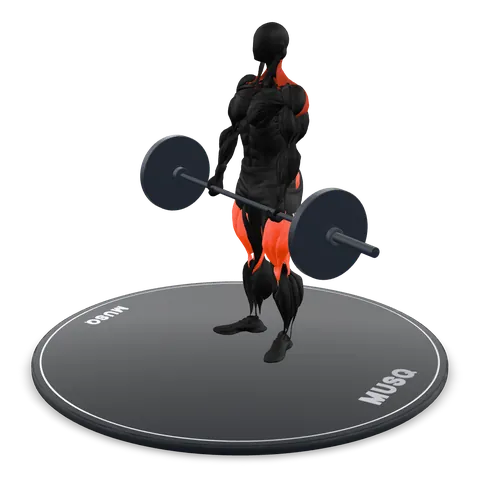
Estimated activation, matching the orange paint on the 3D model.
- Quadricepsprimary
- Gluteus Maximusprimary
- Erector Spinaesecondary
How to do the back squat
- Set the bar at about armpit height in a rack and step under it so it rests on your upper traps.
- Grip the bar just outside your shoulders, squeeze your shoulder blades together and stand up to unrack it.
- Step back and set your feet about shoulder width, toes turned out slightly.
- Take a big breath, brace your core and sit down by bending your hips and knees together.
- Keep your knees tracking over your toes and descend until your hips are at least level with your knees.
- Drive through your whole foot to stand up, keeping your chest up and the bar over mid-foot.
Form cues and common mistakes
The same coaching points MUSQ shows on the lifter in the app.
Bar Position
Where the bar sits on the back changes how the torso has to angle to stay balanced over it.
Why it mattersA high-bar position sits the bar over the middle of the foot with a more upright torso, keeping the quads in the primary role this variation is built for.
Common mistakeLetting the bar drift down onto the rear deltoids, which forces a much deeper forward lean and turns the lift into a de facto low-bar squat.
Do this insteadSet the bar across the traps just below the base of the neck and keep the chest tall through the whole rep.
Grip & Shoulder Blades
Your hands, elbows and shoulder blades build the shelf the bar sits on.
Why it mattersSqueezing the shoulder blades together bunches the upper traps into a firm, muscular shelf for the bar, and elbows held down and slightly back keep the upper back tight. Elbows that rise let it round and tip the trunk forward.
Common mistakeHolding the bar loosely with the wrists bent back and the elbows drifting up or forward, so the shoulder blades relax and the bar rests on a soft upper back.
Do this insteadWrap your thumbs around the bar, keep the wrists in line with the forearms, squeeze the shoulder blades together and pull the elbows down and back before the first rep.
Core Bracing
A stiff torso is what lets the hips and knees move heavy weight safely.
Why it mattersBracing the abs and lower back before the descent turns the trunk into a rigid column that transfers force from the legs to the bar instead of losing it to a bending spine.
Common mistakeLetting the belly relax and the chest collapse forward as the weight gets heavy, rounding the lower back under load.
Do this insteadTake a full breath into the belly, brace hard as if bracing for a punch, and hold that tension from unrack to rerack.
Knee Tracking
The knees have to travel forward and out together with the toes, not independently.
Why it mattersTracking in line with the second toe keeps the load centred in the knee joint; letting the knees drift inward twists the joint and shifts stress onto the inner knee ligaments.
Common mistakeKnees caving inward, especially out of the bottom of a hard rep — a classic sign of the hips giving way to the load.
Do this insteadActively push the knees out over the toes throughout the descent and the drive back up.
Squat Depth
How deep the squat goes decides which muscles do the work.
Why it mattersReaching at least hip-crease-below-knee depth recruits the glutes and the full range of the quadriceps; stopping short trains only the top portion of the lift.
Common mistakeCutting the squat short at quarter or half depth, often to handle more weight than full range allows.
Do this insteadSit down and back until the hip crease drops just below the top of the knee, then drive back up.
Foot Drive
The feet are the base the entire lift pushes against.
Why it mattersDriving through the whole foot — weight balanced across heel and midfoot — keeps the bar path vertical and the hips from shooting up before the chest.
Common mistakeRising onto the toes or letting the weight shift forward onto the front of the foot, which pulls the torso forward and stresses the lower back.
Do this insteadScrew the feet into the floor and push through the whole foot evenly as you stand, keeping the heels down.
● Coming soon to iPhone
Train every lift in 3D with MUSQ
Nearly 500 exercises in 3D, x-ray set-up demos, stretching and a plan built around the days you train. MUSQ is coming soon to iPhone.
Back Squat FAQ
How deep should you squat?
Aim for your hip crease to reach at least knee level while your back stays neutral. Going deeper is fine if your mobility lets you do it without the lower back rounding.
Should your knees go past your toes when squatting?
A little forward knee travel is normal and safe for most people. What matters is that your knees follow the direction of your toes instead of caving in.
High-bar or low-bar squat?
A high bar on the upper traps keeps you more upright and works the quads more; a low bar across the rear delts adds hip bend and lets many lifters move more weight.