Legs · Barbell · Advanced
Deadlift
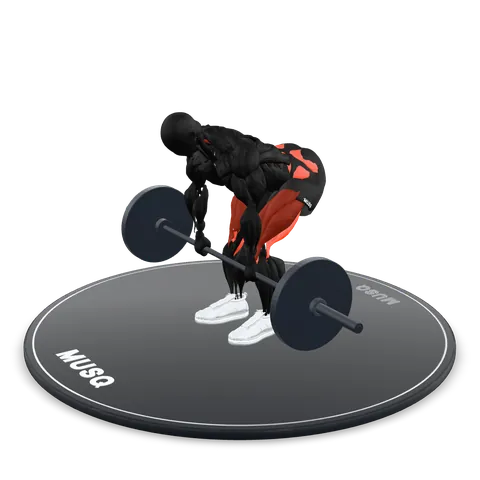
The conventional deadlift lifts a loaded barbell from the floor to standing. It trains the whole posterior chain, from the glutes and hamstrings to the muscles along your spine, together with the quads, lats and grip, which makes it one of the most effective full-body strength lifts.
- Primary muscles
- Gluteus Maximus, Hamstrings, Quadriceps
- Equipment
- Barbell
- Level
- Advanced
- Sets × reps
- 3–5 × 3–5 for strength
- Rest
- 2–4 min
Muscles worked
Estimated activation, matching the orange paint on the 3D model.
- Gluteus Maximusprimary
- Hamstringsprimary
- Quadricepsprimary
- Erector Spinaesecondary
- Latissimus Dorsisecondary
- Trapeziussecondary
How to do the deadlift
- Stand with your mid-foot under the bar, feet about hip width.
- Hinge down and grip the bar just outside your legs with all five fingers.
- Bend your knees until your shins touch the bar, then pull your shoulders down to tighten your lats and flatten your back.
- Take a breath, brace and pull the slack out of the bar.
- Push the floor away, keeping the bar against your legs as it rises.
- Finish standing tall with hips and knees locked out, then lower the bar the way it came up.
Form cues and common mistakes
The same coaching points MUSQ shows on the lifter in the app.
Spine Position
What the lower back does under load is the first thing to get right in the deadlift.
Why it mattersA neutral spine transmits force through the skeleton; a rounded one asks the lumbar discs to do a job they are poor at.
Common mistakeThe lower back rounding as the bar leaves the floor, usually because the hips shot up too early.
Do this insteadTake the slack out of the bar, brace the core, and keep the chest tall so the spine stays neutral throughout.
Grip & Lats
Your grip and your lats tie the bar to your body before it moves.
Why it mattersPulling the shoulders down towards the hips tightens the lats, which hold the bar against the legs so it travels straight. A bar that drifts forward pulls the hips up and rounds the back.
Common mistakeGrabbing the bar with loose hands and relaxed shoulders, so the bar swings away from the legs and the upper back rounds as the weight comes up.
Do this insteadClose all five fingers round the bar, pull the shoulders down to tighten the lats, brace until the back is flat, and keep the bar against your legs the whole rep.
Hip Hinge
The deadlift is a hip hinge loaded with a bar, not a squat.
Why it mattersSending the hips back first lets the glutes and hamstrings drive the pull alongside the quads; sinking the hips into a squat pushes the knees forward into the bar's path.
Common mistakeHips rising faster than the chest, turning the pull into a stiff-legged good morning.
Do this insteadPush the hips back to find the bar, then drive them forward to lock out, keeping shoulders over the bar at the start.
Grip
The grip is the only connection to the bar, and it has to survive the whole set.
Why it mattersA hook grip or an alternating grip stops the bar from rolling out of the hands as the weight gets heavy.
Common mistakeA double-overhand grip that slips before the legs or back give out.
Do this insteadGrip just outside the knees with a hook grip or an alternating grip once the load gets heavy.
Bar Path
The single clearest sign of a good deadlift is what the bar does, not what the lifter feels.
Why it mattersA bar that stays vertical over mid-foot travels the shortest possible distance; one that drifts forward turns into a much harder, less stable pull.
Common mistakeThe bar drifting away from the shins into an S-shaped path, usually because the lats aren't holding it in.
Do this insteadDrag the bar up the shins and thighs in a straight vertical line, thinking 'squeeze the bar into my legs.'
Foot Position
Where the bar starts relative to the feet decides the whole bar path.
Why it mattersThe bar over mid-foot is the shortest, most mechanically efficient path from floor to lockout.
Common mistakeThe bar starting too far forward, over the toes, forcing it away from the body for the whole pull.
Do this insteadSet up with the bar about an inch from the shins, directly over mid-foot, feet roughly hip-width apart.
● Coming soon to iPhone
Train every lift in 3D with MUSQ
Nearly 500 exercises in 3D, x-ray set-up demos, stretching and a plan built around the days you train. MUSQ is coming soon to iPhone.
Deadlift FAQ
What muscles does the deadlift work?
Mainly the glutes, hamstrings and the erector spinae along your spine, with the quads, lats, traps and forearms helping.
Is the deadlift a back or a leg exercise?
Both. The hips and legs drive the lift while the back muscles hold the spine rigid. MUSQ files it under legs because the glutes and hamstrings do most of the lifting.
How do I stop my back rounding when I deadlift?
Set your lats before you pull, brace your core, and let your hips and shoulders rise together instead of shooting the hips up first. If the back still rounds, lower the weight.