Legs · Barbell · Intermediate
Romanian Deadlift
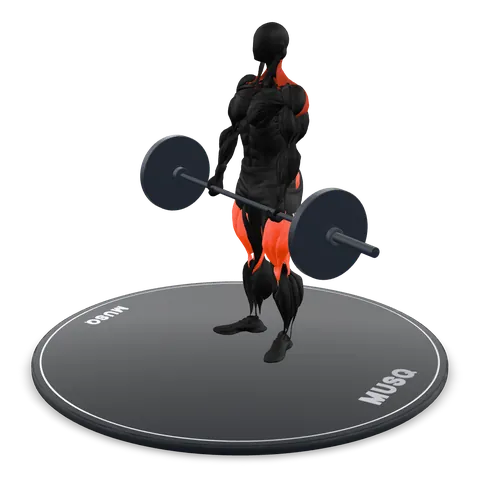
The Romanian deadlift (RDL) is a hip hinge that targets the hamstrings and glutes. Starting from standing, you push your hips back and slide the bar down your thighs with only a slight knee bend, loading the hamstrings in a long, stretched position.
- Primary muscles
- Hamstrings, Gluteus Maximus
- Equipment
- Barbell
- Level
- Intermediate
- Sets × reps
- 3–4 × 6–10
- Rest
- 2 min
Muscles worked
Estimated activation, matching the orange paint on the 3D model.
- Hamstringsprimary
- Gluteus Maximusprimary
- Erector Spinaesecondary
- Quadricepssecondary
How to do the romanian deadlift
- Stand tall holding a barbell at your hips with an overhand grip, feet about hip width.
- Unlock your knees slightly and keep that bend fixed.
- Push your hips back and let the bar slide down your thighs, close to your legs.
- Keep your back flat and lower until you feel a strong hamstring stretch, usually around mid-shin.
- Drive your hips forward to stand up and squeeze your glutes at the top.
Form cues and common mistakes
The same coaching points MUSQ shows on the lifter in the app.
Hip Hinge
A Romanian deadlift is a hip hinge, not a squat with a bar.
Why it mattersPushing the hips straight back keeps the movement loading the hamstrings and glutes through a stretch, instead of turning into a knee-dominant squat.
Common mistakeSitting your hips down like a squat instead of sending them back, which takes the tension off your hamstrings.
Do this insteadStart every rep by pushing the hips backward as if closing a car door with them, letting the torso lower as a result.
Knee Angle
Your knees bend as your hips start back, then hold that bend all the way down.
Why it mattersYour hamstrings cross the knee as well as the hip, so straight knees stretch them sooner and stop your hips early; bending the knees lets your hips travel further back before the stretch stops them.
Common mistakeLocking your knees straight as your hips go back, which runs your hamstrings out of stretch early and cuts the hinge short.
Do this insteadUnlock your knees at the top, let them bend further as your hips start back, then hold that angle until the bar is back up at mid-thigh.
Bar Path
The bar stays close to your legs for the whole rep, travelling almost straight down.
Why it mattersKeeping the bar close to your thighs and shins keeps it under your shoulders, so your lower back does not have to fight the weight.
Common mistakeLetting the bar drift forward away from your legs, which lengthens the lever arm and puts more load on your lower back.
Do this insteadKeep the bar close to your thighs and shins on the way down, and bring it back up the same path.
Spine Position
The spine holds one position for this entire lift — it never rounds and never over-arches.
Why it mattersA flat, neutral back transmits force evenly through the spine; a rounded back concentrates that same load onto the lower discs.
Common mistakeLetting the lower back round as the hips reach the end of their range, usually a sign of going past the hamstrings' available stretch.
Do this insteadSet a neutral spine before the first rep and keep the chest and hips moving together to preserve it through the whole set.
Grip & Lats
Your grip and your lats tie the bar to your body before it moves.
Why it mattersPulling the shoulders down towards the hips tightens the lats, which hold the bar against the legs so it travels straight. A bar that drifts forward pulls the hips up and rounds the back.
Common mistakeGrabbing the bar with loose hands and relaxed shoulders, so the bar swings away from the legs and the upper back rounds as the weight comes up.
Do this insteadClose all five fingers round the bar, pull the shoulders down to tighten the lats, brace until the back is flat, and keep the bar against your legs the whole rep.
Range of Motion
How low the bar travels is decided by the hamstrings, not by a fixed target like the floor.
Why it mattersThe rep ends when your hips cannot travel back any further without your lower back rounding to make up for it; for the lifter shown, that is with the bar just below the knees.
Common mistakeChasing the floor by rounding the back or bending the knees more once the hamstrings run out of range.
Do this insteadLower only until a firm stretch is felt through the hamstrings and the back is about to round, then reverse the movement.
● Coming soon to iPhone
Train every lift in 3D with MUSQ
Nearly 500 exercises in 3D, x-ray set-up demos, stretching and a plan built around the days you train. MUSQ is coming soon to iPhone.
Romanian Deadlift FAQ
What is the difference between a Romanian deadlift and a regular deadlift?
A conventional deadlift starts from the floor with more knee bend. The RDL starts from standing, keeps the knees nearly straight and only goes as low as your hamstrings allow, so it targets them more.
How low should you go on an RDL?
Until your hamstrings are fully stretched while your back stays flat, for most people somewhere between the knees and mid-shin.
Do Romanian deadlifts work the glutes?
Yes. The glutes drive your hips forward out of the stretch, and finishing each rep with a hip squeeze trains them further.