Chest · Barbell · Intermediate
Barbell Bench Press
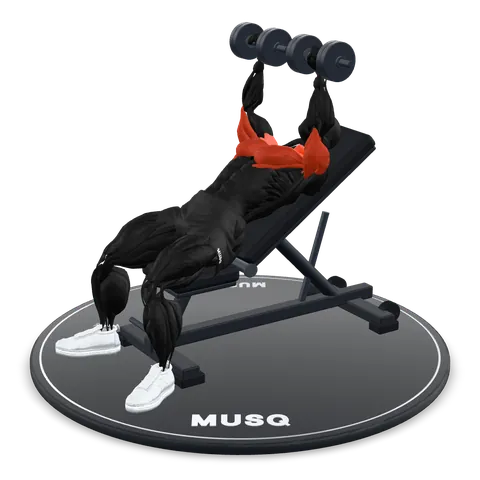
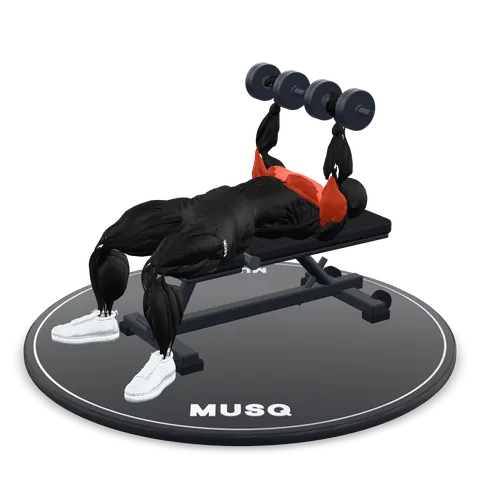
The barbell bench press is the classic upper-body strength lift. Lying on a flat bench, you lower a loaded bar to your lower chest and press it back up, training the chest, front shoulders and triceps together. Most of good form is set-up: a tight upper back, planted feet and a bar path that finishes over your shoulders.
- Primary muscles
- Middle Pectoralis
- Equipment
- Barbell
- Level
- Intermediate
- Sets × reps
- 3–5 × 5–8 for strength · 3–4 × 8–12 for size
- Rest
- 2–3 min
Muscles worked
Estimated activation, matching the orange paint on the 3D model.
- Middle Pectoralisprimary
- Lower Pectoralissecondary
- Triceps Brachiisecondary
- Upper Pectoralissecondary
- Anterior Deltoidsecondary
How to do the barbell bench press
- Lie on the bench with your eyes under the bar and plant your feet flat, a little wider than your hips.
- Grip the bar slightly wider than shoulder width, with the bar low in your palm and stacked over your forearm.
- Pull your shoulder blades back and down into the bench, then lift the bar out to straight arms over your shoulders.
- Breathe in and lower the bar under control to your lower chest, elbows about 45° from your torso.
- Touch, then press up and slightly back so the bar finishes over your shoulders.
- Keep your hips on the bench and your feet driving into the floor on every rep.
Form cues and common mistakes
The same coaching points MUSQ shows on the lifter in the app.
Scapular Position
A stable shoulder blade gives the press a fixed base to push from.
Why it mattersRetracting and depressing the scapula shortens the range the shoulder must travel and keeps the humeral head centred.
Common mistakeLetting the shoulders round forward off the bench, so the press starts from an unstable, protracted position.
Do this insteadPull the shoulder blades back and down into the bench and hold them there for the whole set.
Elbow Position
Elbow angle decides how load splits between the pecs and the shoulder joint.
Why it mattersAt roughly 45° from the torso the pectoralis major stays in its strongest line of pull while the humeral head keeps clearance in the socket.
Common mistakeFlaring the upper arms out to 90° from the torso, which loads the front of the shoulder capsule instead of the chest.
Do this insteadTuck the upper arms toward the ribs as the bar descends, keeping forearms vertical under the wrist.
Wrist Stacking
The bar should sit over the forearm, not behind it.
Why it mattersA stacked wrist transmits force straight down the forearm into the bar with no leak at the joint.
Common mistakeLetting the bar drift back into the fingers, which extends the wrist and shifts the load off the pressing line.
Do this insteadHold the bar low in the palm against the heel of the hand, knuckles up, wrist neutral.
Bar Path
The bar does not travel straight up and down — it touches low and finishes over the shoulders.
Why it mattersTouching the lower chest keeps the forearms vertical and the elbows tucked; pressing up and slightly back ends the rep over the shoulder joint, where the bar is most stable.
Common mistakeLowering to the neck or upper chest, which forces the elbows to flare and loads the front of the shoulder.
Do this insteadLower to the bottom of the breastbone, around the nipple line, then press up and slightly back so the bar finishes above the shoulders.
Leg Drive
The feet are the press's contact with the floor, and they set the tension for the whole body.
Why it mattersDriving the feet into the floor tightens the upper back and arch and carries force up through the torso into the bar.
Common mistakeFeet floating, up on the toes or shuffling mid-set, so the hips shift and the press loses its base.
Do this insteadPlant both feet flat, a little wider than the hips, and push them into the floor through every rep without lifting the hips off the bench.
● Coming soon to iPhone
Train every lift in 3D with MUSQ
Nearly 500 exercises in 3D, x-ray set-up demos, stretching and a plan built around the days you train. MUSQ is coming soon to iPhone.
Barbell Bench Press FAQ
What muscles does the bench press work?
Mainly the chest (pectoralis major), with the front delts and triceps helping. On a flat bench the middle of the chest does the most work; an incline shifts more of it to the upper chest.
Where should the bar touch on a bench press?
Around the bottom of the breastbone, roughly level with the nipples. Touching higher, toward the neck, makes the elbows flare and loads the front of the shoulder.
Should you arch your back when benching?
A small arch that comes from pulling the shoulder blades back and down is normal and keeps the shoulders in a safer position. Keep your glutes on the bench and don't let the lower back take over.