Chest · Dumbbell · Beginner
Incline Dumbbell Press
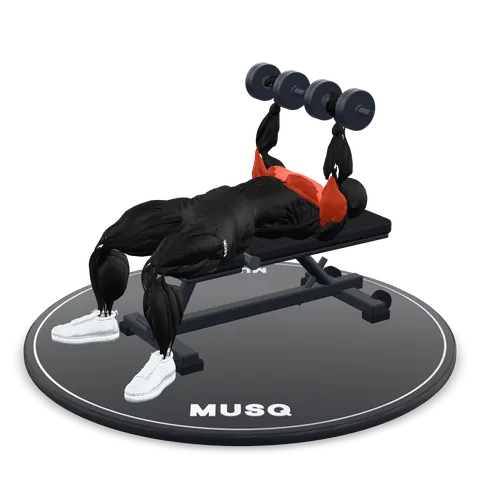
The incline dumbbell press works the upper chest by pressing a pair of dumbbells from an inclined bench. The angle shifts work toward the upper (clavicular) fibres of the pecs and the front shoulders, and the dumbbells let each arm move freely through a deep range.
- Primary muscles
- Upper Pectoralis
- Equipment
- Dumbbell
- Level
- Beginner
- Sets × reps
- 3–4 × 8–12
- Rest
- 90 s–2 min
Muscles worked
Estimated activation, matching the orange paint on the 3D model.
- Upper Pectoralisprimary
- Anterior Deltoidsecondary
- Middle Pectoralissecondary
- Triceps Brachiisecondary
- Lower Pectoralissecondary
How to do the incline dumbbell press
- Set an adjustable bench to about 30° and sit with a dumbbell resting on each thigh.
- Lie back, using your knees to help bring the dumbbells up to your shoulders, palms facing forward.
- Pull your shoulder blades back and down and plant your feet.
- Press the dumbbells up until your arms are straight over your upper chest.
- Lower them under control to the sides of your upper chest, elbows about 45–60° from your torso.
- Pause briefly in the stretch at the bottom, then press again.
Form cues and common mistakes
The same coaching points MUSQ shows on the lifter in the app.
Scapular Position
The incline angle makes it easier to lose the shoulder blades than on a flat bench.
Why it mattersRetracting and depressing the scapula keeps the shoulder joint centred as the dumbbells travel up and back.
Common mistakeShoulders creeping forward as the steeper angle pulls the upper back out of the bench.
Do this insteadSet the shoulder blades back and down before the first rep and hold them through the set.
Elbow Angle
Elbow angle still splits the load between chest and shoulder on an incline.
Why it mattersAround 45–60° keeps the upper pec in its strongest line without handing the rep to the front deltoid.
Common mistakeElbows flaring wide as the dumbbells let them drift outside the frame.
Do this insteadKeep the upper arms tucked to about 45–60° as the dumbbells lower toward the upper chest.
Wrist Stacking
Same rule as any dumbbell press, just at an angle.
Why it mattersA stacked wrist keeps the dumbbell's load running straight through the forearm instead of bending the joint.
Common mistakeThe wrist folding backward as the incline changes the angle the load pulls from.
Do this insteadKeep the wrist neutral and firm, dumbbell centred over the forearm.
Press Path
Bench angle decides how much of this lands on the upper chest.
Why it mattersA 30° incline keeps the clavicular pec fibres in their strongest line without overloading the front shoulder.
Common mistakeSetting the bench too steep and pressing more overhead than up, which shifts the work to the shoulder.
Do this insteadKeep the bench near 30°, lower to the upper chest, then press up and slightly back.
Leg Drive
The incline still needs a solid floor connection to press against.
Why it mattersDriving the feet down keeps the hips anchored against the incline instead of sliding up it.
Common mistakeFeet lifting or sliding, so the hips shift on the incline and the press loses its base.
Do this insteadPlant both feet flat and push down through the whole set.
● Coming soon to iPhone
Train every lift in 3D with MUSQ
Nearly 500 exercises in 3D, x-ray set-up demos, stretching and a plan built around the days you train. MUSQ is coming soon to iPhone.
Incline Dumbbell Press FAQ
What angle is best for the incline dumbbell press?
Around 30° suits most lifters. Much steeper than 45° and the press turns into more of a shoulder exercise.
Does the incline press build the upper chest?
Yes. The incline puts the upper fibres of the chest in a stronger line of pull, so they do more of the work than on a flat bench.
Incline dumbbell or barbell press?
Dumbbells allow a deeper stretch and make each side do its share; a barbell lets you lift heavier. Both build the upper chest.