Chest · Dumbbell · Beginner
Dumbbell Bench Press
The dumbbell bench press trains the chest, front shoulders and triceps like the barbell version, but each arm works on its own. That evens out strength differences between sides and lets the dumbbells travel lower for a deeper chest stretch.
- Primary muscles
- Middle Pectoralis
- Equipment
- Dumbbell
- Level
- Beginner
- Sets × reps
- 3–4 × 8–12
- Rest
- 90 s–2 min
Muscles worked
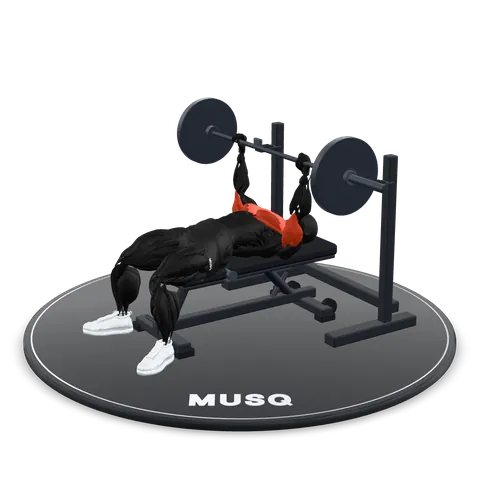
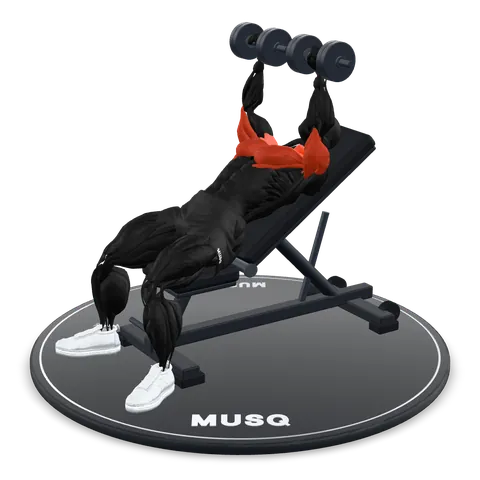
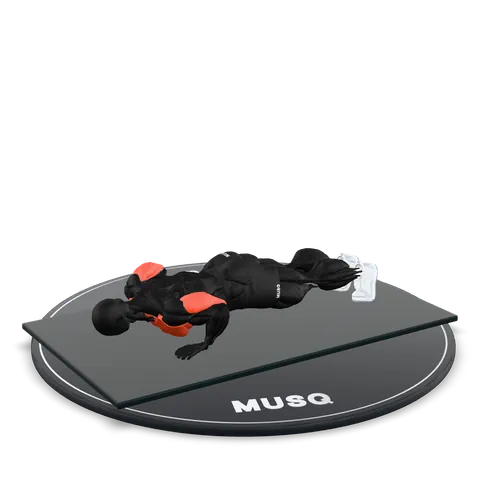
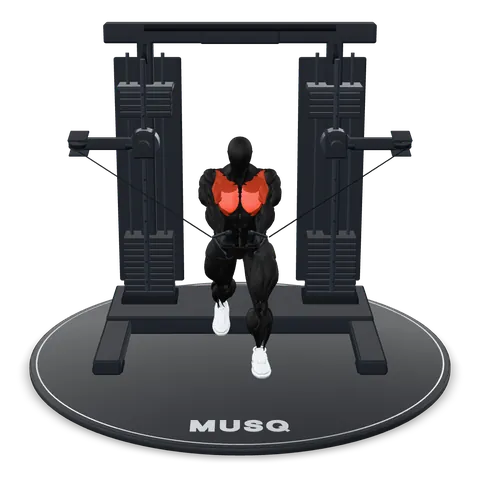
Estimated activation, matching the orange paint on the 3D model.
- Middle Pectoralisprimary
- Lower Pectoralissecondary
- Upper Pectoralissecondary
- Anterior Deltoidsecondary
- Triceps Brachiisecondary
How to do the dumbbell bench press
- Sit on a flat bench with the dumbbells on your thighs, then lie back and bring them to your chest.
- Plant your feet and pull your shoulder blades back and down.
- Press the dumbbells up over your chest until your arms are straight.
- Lower them slowly to the sides of your chest, elbows about 45° from your body.
- Keep your wrists stacked over your elbows and press back up along the same path.
Form cues and common mistakes
The same coaching points MUSQ shows on the lifter in the app.
Scapular Position
Two independent weights ask more of the upper back than a fixed bar.
Why it mattersA retracted, stable scapula gives each arm a fixed base, so the dumbbells travel on matching paths.
Common mistakeShoulders rounding forward, which lets the two dumbbells drift out of sync.
Do this insteadRetract the shoulder blades into the bench and keep them still through the set.
Elbow Angle
Dumbbells let the elbow travel more freely than a barbell — that freedom has to be controlled.
Why it mattersKeeping the upper arms around 45–60° protects the shoulder; dropping the elbows below torso level stretches the front of the joint under load.
Common mistakeLetting the elbows drop below the line of the torso at the bottom, opening the shoulder up.
Do this insteadLower until the upper arm is level with the torso, elbows around 45–60° out.
Wrist Stacking
Each dumbbell needs its own stacked wrist, with no bar to keep it honest.
Why it mattersA neutral wrist keeps the dumbbell's weight running straight through the forearm.
Common mistakeWrists bending back under the dumbbell's weight, especially as the set gets hard.
Do this insteadKeep the wrist straight and firm, dumbbell resting over the middle of the forearm.
Press Path
Dumbbells travel in a slight arc that a fixed bar cannot.
Why it mattersThe extra range lets the dumbbells nearly touch at the top and sit slightly wider at the bottom, giving the pec a deeper stretch.
Common mistakePressing straight up and down like a barbell, which wastes the range dumbbells allow.
Do this insteadLower until the dumbbells are level with the chest, then press up and slightly in so they finish over the shoulders.
Leg Drive
The base matters even more with two independently balanced weights.
Why it mattersPlanted feet keep the torso still, which is what lets each arm press on the same path.
Common mistakeFeet floating or shifting, adding instability to an already less-stable lift.
Do this insteadPlant both feet flat and drive them into the floor for the whole set.
● Coming soon to iPhone
Train every lift in 3D with MUSQ
Nearly 500 exercises in 3D, x-ray set-up demos, stretching and a plan built around the days you train. MUSQ is coming soon to iPhone.
Dumbbell Bench Press FAQ
Is the dumbbell bench press better than the barbell bench?
Neither is strictly better. Dumbbells train each side on its own and allow more range of motion; the barbell lets you handle more weight. Many lifters use both.
How heavy should the dumbbells be compared to my barbell bench?
Each dumbbell usually ends up a bit under half of your barbell weight, because balancing two weights takes extra control.
How do I get heavy dumbbells into position?
Rest them on your thighs, then lie back and use a small kick of the knees to bring them to your chest as your back reaches the bench.