Legs · Machine · Beginner
Leg Extension
The leg extension is a machine exercise that isolates the quadriceps. Seated with a pad on your lower shins, you straighten your knees against resistance, which makes it useful for building the quads directly or adding volume after squats.
- Primary muscles
- Quadriceps
- Equipment
- Machine
- Level
- Beginner
- Sets × reps
- 3 × 10–15
- Rest
- 60 s
Muscles worked
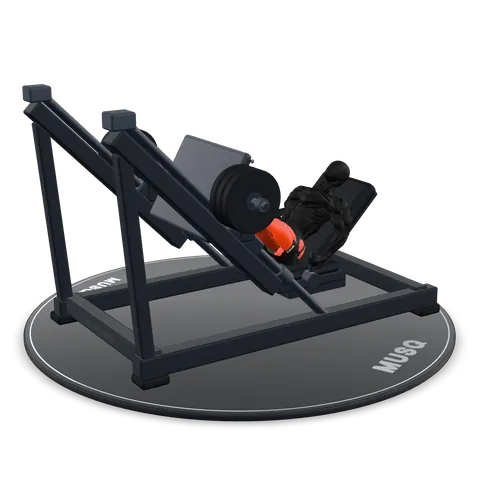
Estimated activation, matching the orange paint on the 3D model.
- Quadricepsprimary
How to do the leg extension
- Adjust the seat so your knees line up with the machine's pivot point.
- Set the pad on the front of your lower shins, just above your ankles.
- Hold the handles and keep your hips pressed into the seat.
- Straighten your knees until your legs are fully extended and squeeze your quads.
- Lower slowly, taking two to three seconds on the way down.
Form cues and common mistakes
The same coaching points MUSQ shows on the lifter in the app.
Pad Position
Where the shin pad sits changes the leverage on the knee.
Why it mattersResting the pad just above the ankle, not on it, gives the quads the longest, most controlled lever to extend against.
Common mistakeLetting the pad sit too high on the shin or right on the ankle joint, shortening or awkwardly loading the lever.
Do this insteadAdjust the pad to rest just above the ankle bone before starting the set.
Tempo
A leg extension is easy to turn into a swinging, momentum-driven rep.
Why it mattersA slow, controlled tempo keeps the quads doing the lifting instead of letting the weight stack's own momentum carry the leg up and down.
Common mistakeKicking the weight up fast and letting it drop, using momentum instead of muscle for most of the rep.
Do this insteadExtend and lower the leg at a controlled, even pace for the whole set.
Top Squeeze
The very top of the rep is where the quads are shortest and hardest to keep tense.
Why it mattersA brief pause and squeeze at full extension keeps the quads under tension through the point of the range they most want to skip.
Common mistakeBouncing off the top of the rep the instant the leg straightens, without any pause.
Do this insteadExtend fully, pause for a moment and squeeze the quads, then lower under control.
Hip Position
The hips and back should stay exactly where the seat put them.
Why it mattersKeeping the hips flush against the seat back isolates the knee extension to the quads, instead of letting the hip flexors and lower back help lift the weight.
Common mistakeArching the back or lifting the hips off the seat to help swing the weight up as the set gets hard.
Do this insteadKeep the hips and back pressed into the seat through every rep, using the handles to stay anchored if needed.
The Negative
The lowering half of a leg extension does as much work as the lift.
Why it mattersControlling the negative through the full range keeps the quads under tension on the way down instead of just letting gravity and the stack do the work.
Common mistakeLetting the weight stack drop quickly back down once the top of the rep is reached.
Do this insteadLower the weight under control through the full range before starting the next rep.
● Coming soon to iPhone
Train every lift in 3D with MUSQ
Nearly 500 exercises in 3D, x-ray set-up demos, stretching and a plan built around the days you train. MUSQ is coming soon to iPhone.
Leg Extension FAQ
Are leg extensions bad for your knees?
Not for healthy knees when the machine is set up correctly and the weight is controlled. Line your knee up with the pivot and avoid swinging heavy weights.
Leg extensions or squats?
Squats train the whole leg and core; leg extensions isolate the quads. They complement each other.
Should I pause at the top?
Yes. A one-second squeeze at full extension makes the quads work through the hardest part of the range.