Back · Barbell · Intermediate
Barbell Bent-Over Row
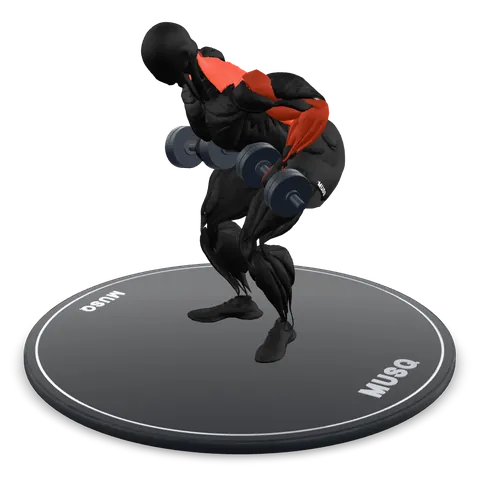
The barbell bent-over row builds a thick, strong upper back. Hinged forward with a flat back, you row the bar to your lower ribs, training the middle traps, rhomboids, rear delts and lats while your hips and core hold the position.
- Primary muscles
- Middle Trapezius, Posterior Deltoid, Rhomboids
- Equipment
- Barbell
- Level
- Intermediate
- Sets × reps
- 3–4 × 6–10
- Rest
- 2 min
Muscles worked
Estimated activation, matching the orange paint on the 3D model.
- Middle Trapeziusprimary
- Posterior Deltoidprimary
- Rhomboidsprimary
- Latissimus Dorsisecondary
- Biceps Brachiisecondary
How to do the barbell bent-over row
- Stand with feet hip width and grip the bar just outside your knees with an overhand grip.
- Hinge at your hips until your torso is around 45° or lower, knees slightly bent and back flat.
- Let the bar hang at arm's length below your shoulders.
- Row the bar to your lower ribs by driving your elbows back and squeezing your shoulder blades together.
- Lower it under control without letting your torso rise or your back round.
Form cues and common mistakes
The same coaching points MUSQ shows on the lifter in the app.
Scapular Position
The row starts and ends with the shoulder blades, not the arms.
Why it mattersSqueezing the blades together at the top is what turns an arm pull into a back exercise.
Common mistakeThe shoulders staying protracted throughout, so the lats and traps never fully engage.
Do this insteadRetract the shoulder blades hard at the top of every rep, then let them protract slightly on the way down.
Elbow Path
Where the elbows travel decides which muscles do the pulling.
Why it mattersIn rowing studies the mid-back and rear delts worked harder as the elbows moved out from the body, while the lats worked harder and the pull was strongest with them tucked in; a moderate angle trains the whole upper back and keeps the bar close.
Common mistakeElbows flaring out wide to the sides, up toward shoulder height.
Do this insteadDrive the elbows back and up at a slight angle out from the body, keeping them below shoulder height.
Grip
Grip width changes how far the bar has to travel and which fibres take the most load.
Why it mattersA shoulder-width overhand grip keeps the forearms vertical under the bar for an efficient pulling line.
Common mistakeA grip so wide the elbows flare out toward shoulder height instead of tracking back.
Do this insteadTake an overhand grip roughly shoulder-width apart.
Bar Path
The bar should travel in a straight line, close to the body, from thighs to ribs.
Why it mattersRowing to the lower ribs or upper abdomen keeps the elbows tracking back rather than flaring, and keeps the bar close to the body's centre of mass.
Common mistakeRowing the bar high up the chest, which drags the elbows out wide.
Do this insteadPull the bar to the lower ribs or upper abdomen, keeping it close to the body the whole way up.
Hip Hinge
The bent-over row is a hip hinge with a pull layered on top of it.
Why it mattersHinging to roughly 45° above horizontal loads the back muscles doing the pulling without asking the lower back to hold a fully bent-over position under load.
Common mistakeThe torso rising toward vertical on each rep, turning the row into a shrug with momentum.
Do this insteadPush the hips back, soften the knees, and hold the torso still at roughly 45° for the whole set.
● Coming soon to iPhone
Train every lift in 3D with MUSQ
Nearly 500 exercises in 3D, x-ray set-up demos, stretching and a plan built around the days you train. MUSQ is coming soon to iPhone.
Barbell Bent-Over Row FAQ
What muscles does the bent-over row work?
The middle traps, rhomboids and rear delts most, with the lats, biceps and the lower-back muscles that hold your hinge.
How bent over should I be?
Around 45° or lower. The more horizontal your torso, the harder the upper back works, but only go as low as you can hold with a flat back.
Overhand or underhand grip?
An overhand grip emphasises the upper back; an underhand grip keeps the elbows closer to your body and brings in more lats and biceps.