Back · Dumbbell · Beginner
Dumbbell Row
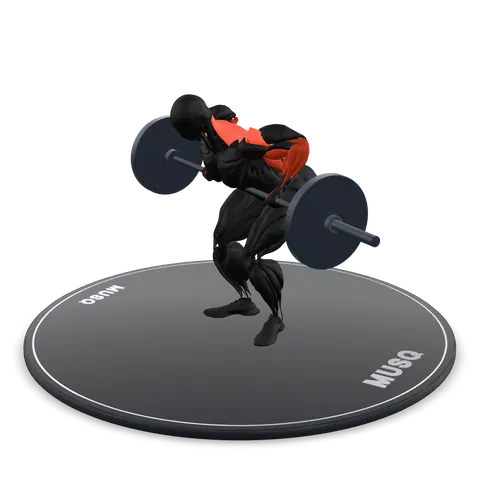
This dumbbell row is done bent over with a dumbbell in each hand. Holding a flat-backed hinge, you row both dumbbells toward your hips, which trains the lats and middle back through a longer range than a barbell allows.
- Primary muscles
- Latissimus Dorsi, Middle Trapezius
- Equipment
- Dumbbell
- Level
- Beginner
- Sets × reps
- 3–4 × 8–12
- Rest
- 90 s
Muscles worked
Estimated activation, matching the orange paint on the 3D model.
- Latissimus Dorsiprimary
- Middle Trapeziusprimary
- Biceps Brachiisecondary
How to do the dumbbell row
- Hold a dumbbell in each hand with a neutral grip, palms facing each other.
- Hinge at your hips with soft knees until your torso leans well forward and your back is flat.
- Let your arms hang straight down below your shoulders.
- Row both dumbbells toward your hips, elbows brushing your ribs, and squeeze your shoulder blades together.
- Lower until your arms are fully straight, keeping your torso still.
Form cues and common mistakes
The same coaching points MUSQ shows on the lifter in the app.
Scapular Position
Two dumbbells give each side its own shoulder blade to manage.
Why it mattersRetracting both blades at the top keeps the pull symmetrical and puts the back muscles, not the arms, at the end range.
Common mistakeOne or both shoulders staying rounded forward through the set.
Do this insteadPull both shoulder blades back and together at the top of every rep.
Elbow Path
The elbow path decides whether this is a back exercise or an arm exercise.
Why it mattersDriving the elbows back toward the hip keeps the lats in their strongest line of pull.
Common mistakeElbows flaring wide or drifting forward, shifting the load onto the shoulders and arms.
Do this insteadKeep the elbows close to the torso and drive them back toward the hip.
Grip
A neutral grip keeps both wrists in a strong, comfortable position through a long range.
Why it mattersPalms facing each other let the shoulder move through its natural rowing arc without twisting the forearm.
Common mistakeLetting the dumbbells drift out to the sides instead of tracking straight up.
Do this insteadHold a neutral grip and let the arms extend fully at the bottom of every rep.
Row Path
Where the dumbbells finish decides which fibres get the work.
Why it mattersRowing toward the hip keeps the elbows tracking back and biases the lats; rowing toward the chest flares the elbows and biases the rear shoulder.
Common mistakePulling the dumbbells up toward the chest, flaring the elbows out to the sides.
Do this insteadPull both dumbbells toward the hips, elbows brushing the ribs.
Torso Position
The bent-over torso position is the base the whole row is built on.
Why it mattersA flat back with the hips hinged back keeps the spine safe and the lats loaded through a full range.
Common mistakeThe back rounding, or the torso swinging upright to help heave the weight up.
Do this insteadHinge at the hips, flatten the back, and keep the torso still for the whole set.
● Coming soon to iPhone
Train every lift in 3D with MUSQ
Nearly 500 exercises in 3D, x-ray set-up demos, stretching and a plan built around the days you train. MUSQ is coming soon to iPhone.
Dumbbell Row FAQ
What muscles does the dumbbell row work?
The lats and middle traps most, with the rhomboids, rear delts and biceps helping.
Two-arm or one-arm dumbbell row?
Rowing both dumbbells while bent over also trains your hips and lower back to hold the hinge; the one-arm row with a hand on a bench takes the lower back out of it and lets you go heavier per side.
Should I row to my chest or my hips?
Toward your hips. Pulling the elbows back along your ribs keeps the lats working; rowing high to the chest shifts the work to the upper traps and rear delts.