Back · Cable · Beginner
Seated Cable Row
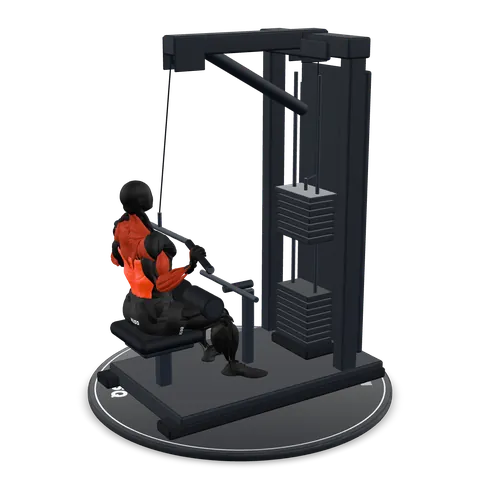
The seated cable row trains the middle back under steady cable tension. Sitting tall with your feet braced, you pull the handle to your stomach and squeeze your shoulder blades together, building the lats, middle traps and rhomboids.
- Primary muscles
- Latissimus Dorsi, Middle Trapezius
- Equipment
- Cable
- Level
- Beginner
- Sets × reps
- 3–4 × 10–12
- Rest
- 90 s
Muscles worked
Estimated activation, matching the orange paint on the 3D model.
- Latissimus Dorsiprimary
- Middle Trapeziusprimary
- Biceps Brachiisecondary
How to do the seated cable row
- Sit with your feet on the platform and your knees slightly bent.
- Take the handle and sit tall, arms straight and chest up.
- Pull the handle toward your stomach, driving your elbows back close to your sides.
- Squeeze your shoulder blades together at the end of the pull.
- Let the handle return slowly until your arms are straight, without rounding your back.
Form cues and common mistakes
The same coaching points MUSQ shows on the lifter in the app.
Scapular Position
The seated row rewards setting the shoulder before the arms ever move.
Why it mattersRetracting the shoulder blades first, before bending the elbows, builds a stable platform for the lats to pull from.
Common mistakeStarting the pull with the arms, then trying to retract the blades afterward.
Do this insteadRetract the shoulder blades first, then bend the elbows to finish the pull.
Elbow Path
Driving with the elbows, not curling with the arms, is what keeps this a back exercise.
Why it mattersDriving the elbows straight back, rather than curling the hands in, limits how much the biceps take over.
Common mistakeCurling the handle in with the forearms before the elbows even move.
Do this insteadLead the pull with the elbows, driving them straight back past the torso.
Grip
A neutral grip suits the seated row's straight-back pulling line.
Why it mattersPalms facing each other let the elbow track straight back without twisting the wrist.
Common mistakeCutting the stretch short at the front instead of reaching the arms fully forward.
Do this insteadHold a neutral grip and let the arms extend fully forward between reps.
Row Path
The target sits at the upper abdomen, not the chest.
Why it mattersPulling to the upper abdomen keeps the elbows tracking back along the torso rather than flaring up toward the chest.
Common mistakePulling the handle up to the chest, which flares the elbows and shifts the work to the rear delts.
Do this insteadPull the handle to the upper abdomen, elbows brushing the ribs.
Base Position
A braced lower body is what lets the upper body move safely.
Why it mattersSoft knees and firmly braced feet on the platform stop the legs from taking over the pull.
Common mistakeLocking the knees straight, which transfers load into the lower back on every rep.
Do this insteadKeep the knees slightly bent and the feet pressed firmly into the platform.
● Coming soon to iPhone
Train every lift in 3D with MUSQ
Nearly 500 exercises in 3D, x-ray set-up demos, stretching and a plan built around the days you train. MUSQ is coming soon to iPhone.
Seated Cable Row FAQ
Which handle is best for seated cable rows?
A close neutral-grip (V) handle suits most lifters; a wide bar shifts work toward the upper back and rear delts.
Should you lean back on seated rows?
Only slightly. Rocking back and forth turns the row into a lower-back swing; keep your torso mostly still and let your arms and shoulder blades do the work.
Seated cable row or bent-over row?
The cable row is easier on the lower back because you're seated and supported; the bent-over row also trains your hips and core to hold the hinge.