Back · Bodyweight · Intermediate
Pull-Up
The pull-up is the classic bodyweight back exercise. Hanging from a bar with an overhand grip, you pull your chest up toward the bar, training the lats, upper back and biceps while building grip and core strength.
- Primary muscles
- Latissimus Dorsi
- Equipment
- Bodyweight
- Level
- Intermediate
- Sets × reps
- 3–4 × 5–10, or as many clean reps as you can
- Rest
- 2 min
Muscles worked
Estimated activation, matching the orange paint on the 3D model.
- Latissimus Dorsiprimary
- Biceps Brachiisecondary
- Middle Trapeziussecondary
How to do the pull-up
- Hang from the bar with an overhand grip a little wider than your shoulders.
- From a dead hang, pull your shoulder blades down and back before bending your elbows.
- Drive your elbows down and back to pull your chest toward the bar.
- Keep your legs still and pull until your chest approaches the bar.
- Lower yourself under control all the way to straight arms.
Form cues and common mistakes
The same coaching points MUSQ shows on the lifter in the app.
Scapular Position
The pull-up starts before the elbows bend at all.
Why it mattersDepressing the shoulder blades first — 'packing' the shoulder — creates a stable base for the lats to pull from.
Common mistakeHanging in a fully shrugged position and pulling straight from there.
Do this insteadPull the shoulder blades down and back before bending the elbows, then pull.
Elbow Path
The overhand grip naturally pulls the elbows out to the sides — that's fine, within reason.
Why it mattersDriving the elbows down and back, finishing wide, keeps the lats and lower traps in their strongest line for this grip.
Common mistakeElbows drifting forward, turning the pull into mostly a biceps curl.
Do this insteadDrive the elbows down and back, letting them travel slightly out to the sides.
Grip
Grip width and orientation set the whole exercise.
Why it mattersAn overhand grip just outside the shoulders emphasises shoulder adduction and hits the lats through a wide range.
Common mistakeA grip so wide the shoulders can't move through a full range.
Do this insteadTake an overhand grip a little wider than the shoulders.
Range of Motion
How high is high enough is decided by the chest, not the chin.
Why it mattersDriving the chest toward the bar ensures the shoulder finishes fully adducted, getting the lats through their complete range.
Common mistakeCraning the neck to get the chin over the bar while the shoulders barely move.
Do this insteadPull until the chest, not just the chin, approaches the bar.
Body Control
A strict pull-up is a still one from the hips down.
Why it mattersKeeping the legs and hips still means the lats and arms do all the work, instead of momentum from a leg swing.
Common mistakeKipping — swinging the legs and hips to sling the body up and over the bar.
Do this insteadKeep the legs still, or crossed at the ankles, and let the upper body do all the work.
● Coming soon to iPhone
Train every lift in 3D with MUSQ
Nearly 500 exercises in 3D, x-ray set-up demos, stretching and a plan built around the days you train. MUSQ is coming soon to iPhone.
Pull-Up FAQ
What muscles do pull-ups work?
Mainly the latissimus dorsi, with the biceps, middle and lower traps, rhomboids, rear delts and forearms helping.
How can I do my first pull-up?
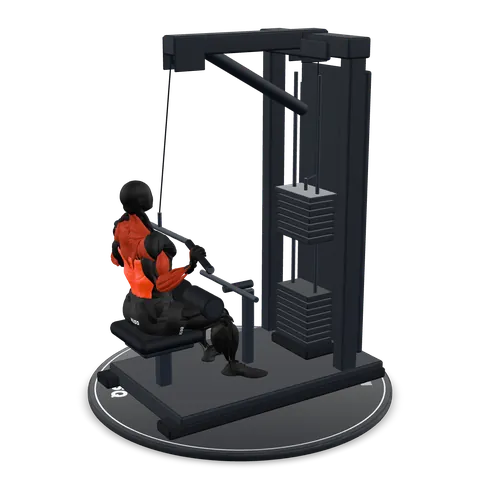
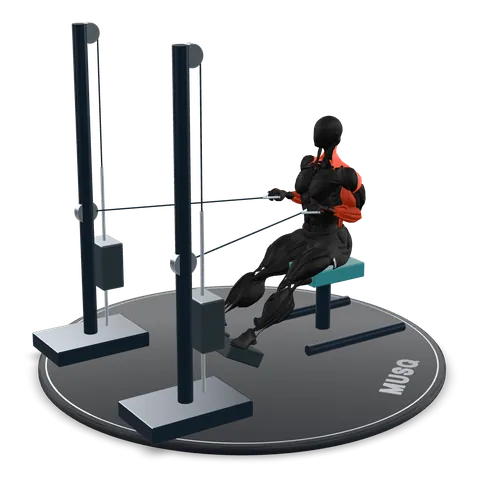
Practise slow negatives (jump to the top, lower for 3–5 seconds), dead hangs and band-assisted pull-ups, and train lat pulldowns and rows.
Pull-up or chin-up?
Pull-ups use an overhand grip and lean more on the lats; chin-ups use an underhand grip and bring in more biceps, so most people find them a little easier.